Professional Learning Outcomes
Integrative Mind Training: Professional Learning Outcomes
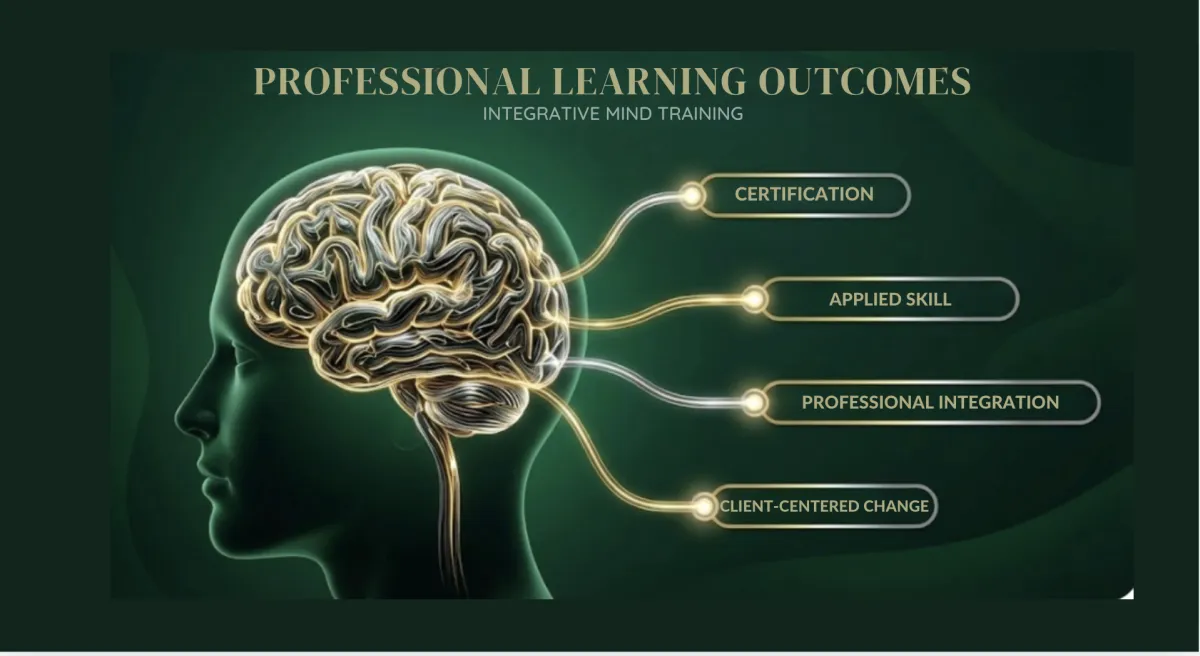
Upon successful completion of the 220-hour Professional Hypnotherapy Certification, students will have moved from foundational understanding into applied practitioner skill.
This certification is designed to help mental health professionals and serious practitioners develop the structure, confidence, and ethical awareness required to integrate hypnotherapy into client-centered work.
Students graduate with a working understanding of hypnosis, subconscious architecture, practitioner ethics, induction methods, hypnotic communication, strategic change processes, specialized applications, and professional integration.
1. Foundations of Trance & Subconscious Architecture
Professional Definitions of Hypnosis: Develop a clear understanding of what hypnosis is, what it is not, and how to differentiate focused attention, trance phenomena, suggestibility, and naturally occurring hypnotic states.
The Model of the Mind: Study the relationship between the conscious mind, subconscious mind, and unconscious processes, including the role of the Critical Faculty in filtering new ideas and patterns.
Rules of Mind & Pattern Formation: Learn the foundational principles behind how patterns are formed and reinforced, including expectation, repetition, emotion, association, and the role of imagination in subconscious change.
Reticular Activating System (RAS): Understand how selective attention and mental filtering influence what clients notice, reinforce, and respond to in daily life.
Trance Recognition & Calibration: Build the observational skills needed to recognize trance indicators, establish baselines, and begin understanding how hypnotic responsiveness presents in real time.
2. Applied Induction Mastery: The Big Five
Core Induction Fluency: Develop working fluency in IMT’s five foundational inductions: Progressive Relaxation, Guided Imagery, Focusing Techniques, the Dave Elman Induction, and the Director Technique.
Progressive Relaxation: Learn a structured approach to helping clients settle into trance through physical and mental relaxation.
Guided Imagery: Use imagination, sensory language, and internal imagery to facilitate focused hypnotic experience.
Focusing Techniques: Apply fixation-based methods drawn from foundational hypnotic practice.
The Dave Elman Induction: Learn one of the program’s core approaches for facilitating depth, responsiveness, and mental relaxation.
The Director Technique: Facilitate visual and kinesthetic scene-based work that supports deeper subconscious engagement.
Deepening Methods: Learn how to strengthen trance through methods such as fractionation, countdowns, and other structured deepening approaches.
Responsiveness Testing & Convincers: Practice tools such as the Lemon Test, Magnetic Fingers, Hand Clasp, and Eye Catalepsy to assess and strengthen hypnotic responsiveness.
Ideomotor Communication: Develop foundational skill in finger signaling, yes/no signaling, and subconscious communication methods used throughout hypnotherapy work.
3. Strategic Change Methods
The MetaPattern of Change: Learn the four-step structure used throughout IMT’s approach to change: association, dissociation, resource integration, and reassociation. This gives students a framework for understanding how hypnotherapy methods can support clients in shifting old patterns and accessing new internal responses.
Hypnotic Communication: Develop skill with direct suggestion, indirect suggestion, language patterns, metaphor, and structured hypnotic communication designed to engage the subconscious mind with clarity and precision.
Resource Installation & Future Pacing: Learn methods for helping clients access internal resources, rehearse new responses, and prepare the mind for future situations with greater flexibility and choice.
Reframing, Belief Change & Reimprinting: Study structured approaches for helping clients revisit old conclusions, update internal meaning, and create new associations where appropriate and within scope.
Parts Integration & Conflict Resolution: Learn methods for working with inner conflict, competing motivations, and parts-based patterns in a client-centered and ethical way.
Deep Trance Identification: Study modeling-based techniques designed to support perspective shifts, skill development, and identity-level change.
4. Specialized Applications
Habit Change: Learn structured hypnotherapy methods for working with habits such as smoking cessation, weight management patterns, emotional eating, and self-image-related behavior.
Stress Reduction & Self-Regulation: Develop methods that support relaxation, self-hypnosis, focused attention, and long-term self-regulation skills.
Performance Enhancement: Study approaches for helping clients strengthen focus, confidence, internal rehearsal, and goal-directed behavior.
Regression Considerations: Learn how regression is approached with attention to ethics, false memory precautions, client stability, scope, and professional responsibility.
Pain Management Applications: Study complementary comfort techniques, including glove anesthesia and related methods, with clear emphasis on medical clearance and appropriate scope.
Group Hypnosis & Community Education: Learn how hypnotherapy principles may be adapted for group settings, stress reduction, performance support, and educational presentations.
5. Ethics, Scope & Professional Practice
IACT Ethics & Professional Responsibility: Understand the ethical standards that guide professional hypnotherapy practice, including client welfare, informed consent, confidentiality, documentation, boundaries, and scope of practice.
The Hypnotic Relationship: Learn how to establish rapport, build cooperation, clarify expectations, and use the “hypnotic contract” so hypnosis remains a collaborative, client-centered process.
Scope, Referrals & Complementary Care: Develop clear awareness of when hypnotherapy is appropriate, when referral is necessary, and how to practice within professional limitations.
Professional Practice Structure: Learn the administrative and professional foundations of practice, including intake forms, documentation, informed consent procedures, referral relationships, virtual session considerations, and long-term professional development.
Graduation Requirements
To receive the Professional Hypnotherapy Certification from Integrative Mind Training, students must complete the following:
Live Interactive Training: Verification of 110 live, interactive training hours.(Active Case work is included)
Independent Study & Case Work: Completion of 110 independent study hours, including research and documented case studies.
Ethics Requirement: Documented completion of the mandatory 3-hour Ethics Intensive.
Written Certification Exam: Achievement of a minimum 80% score on the final comprehensive examination.
Practical Skills Assessment: Successful completion of a client-based skills demonstration where students show their ability to facilitate hypnotherapy work in a professional, ethical, and client-centered manner.
Stay Connected with IMT
Receive insights on hypnotherapy training, subconscious methodology, and the professional use of hypnosis in client-centered work.
Info
Home
About IMT
Certification Curriculum
Learning Outcomes
Career Trajectories
IACT Ethical Standards
Contact Us
Connect with IMT on LinkedIn
For mental health professionals who know insight alone is not always enough.
Follow us for perspectives on subconscious methodology, professional hypnotherapy certification, and client-centered change.

Integrative Mind Training © Copyright 2026. All rights reserved. Privacy Terms & Conditions
IACT Certified & Accredited Training Center.
Medical Disclaimer : Hypnotherapy is a clinical modality that is complementary to, not a substitute for, conventional medical or psychiatric care.