Professional Integration Pathways
Hypnotherapy does not have to exist outside your current profession.
For many IMT students, this certification becomes a way to deepen the work they are already doing.
Mental health professionals may use this training to better understand subconscious patterns, support clients beyond insight alone, and bring a more structured approach to root-cause change into their existing client work.
Healthcare professionals may use hypnosis education to support relaxation, comfort, stress reduction, habit change, and patient-centered communication within their appropriate scope.
Other helping professionals may use this training to develop a more sophisticated understanding of change, behavior, suggestion, self-regulation, and the subconscious mind.
IMT gives serious practitioners a professional framework for integrating hypnotherapy into the path they are already building.
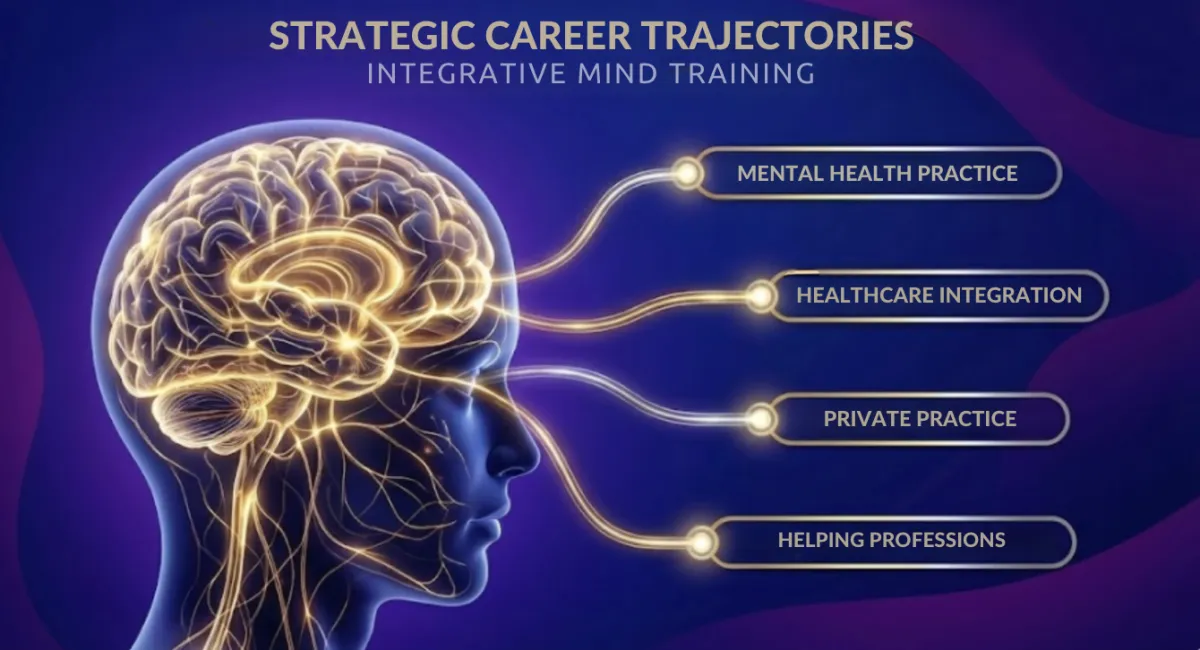
Path I: Mental Health Practice Integration
Ideal for: Licensed Mental Health Counselors, Social Workers, Marriage and Family Therapists, Psychologists, and other mental health professionals.
For many mental health professionals, clients do not stay stuck because they lack insight.
They may understand the pattern, know where it started, and still struggle to change it.
This pathway speaks to clinicians who want to complement their existing client work with a structured understanding of hypnosis, subconscious patterns, emotional learning, habit formation, and client-centered change.
How IMT supports this path:
Subconscious-Level Methodology: Learn how subconscious patterns form, persist, and influence repeated client responses.
Integration With Existing Client Work: Explore how hypnotherapy may complement counseling, psychotherapy, treatment planning, and trauma-informed considerations within appropriate scope.
Root-Cause Oriented Tools: Study methods such as affect bridge, reimprinting, belief change, reframing, parts integration, and regression considerations with clear ethical boundaries.
Professional Responsibility: Strengthen your understanding of informed consent, documentation, confidentiality, referral awareness, and scope of practice.
Path II: Healthcare Integration
Ideal for: Nurses, chiropractors, integrative health professionals, wellness-oriented healthcare providers, and patient-centered practitioners.
Healthcare professionals often work with clients and patients whose stress, habits, fear, discomfort, or emotional responses can influence their care experience.
This pathway is for healthcare professionals who want to understand hypnosis as a complementary, client-centered modality that may support relaxation, comfort, stress reduction, habit change, patient education, and self-regulation within their existing professional scope.
How IMT supports this path:
Patient-Centered Communication: Learn how language, expectation, attention, and suggestion can influence the care experience.
Stress Reduction & Self-Regulation: Study hypnosis-based approaches for relaxation, focused attention, and internal regulation.
Complementary Comfort Techniques: Learn about pain management applications such as glove anesthesia and comfort techniques with clear emphasis on medical clearance and appropriate scope.
Interdisciplinary Collaboration: Understand referrals, documentation, professional communication, and how to integrate hypnosis responsibly alongside other care providers.
Path III: Private Practice Expansion
Ideal for: Mental health professionals, healthcare professionals, hypnotherapists, coaches, and established helping professionals who want to add structured hypnotherapy services to their work.
For practitioners who already serve clients independently, IMT can become a way to expand the depth and structure of their services.
This pathway focuses on integrating hypnotherapy into an existing private practice or building a professional hypnotherapy offering with ethical systems, clear positioning, and responsible client care.
How IMT supports this path:
Professional Practice Structure: Study intake, informed consent, documentation, case forms, referrals, and virtual session considerations.
Client-Centered Hypnotherapy Services: Learn how to structure sessions around well-formed outcomes, ecology checks, rapport, and collaborative change.
Specialized Applications: Explore habit change, stress reduction, performance enhancement, self-hypnosis, and other hypnotherapy applications within scope.
Professional Identity: Clarify how hypnotherapy fits into your existing work, language, services, and long-term professional development.
Path IV: Helping Professions & Interdisciplinary Work
Ideal for: Coaches, wellness practitioners, educators, spiritual care providers, bodyworkers, consultants, and other client-centered professionals.
Not every IMT student comes from a mental health or healthcare background.
Some are helping professionals who want a more substantive understanding of human change, subconscious learning, focused attention, internal imagery, suggestion, and self-regulation.
This pathway is for professionals who want to use hypnosis education responsibly, without overstepping their scope or presenting themselves as mental health or medical providers.
How IMT supports this path:
Foundations of Hypnosis: Understand what hypnosis is, what it is not, and how trance naturally occurs.
Ethical Scope Awareness: Learn the boundaries of responsible hypnotherapy practice, including when referral is necessary.
Behavioral Change Support: Study tools for confidence, performance, habits, stress reduction, and self-directed change.
Professional Communication: Develop clear, ethical language for explaining your work without making diagnostic, medical, or therapeutic claims.
The Same Professional Standard Across Every Path
No matter how you plan to integrate hypnotherapy into your work, IMT students complete the same substantive certification pathway.
Whether you are a mental health professional, healthcare provider, private practice practitioner, or helping professional, the training is designed to support ethical application, clear scope, and real practitioner development.
Students complete:
220 Total Hours of Study: 110 live interactive training hours and 110 independent study, practice, fieldwork, and documented case study hours.
Ethics Requirement: Completion of the mandatory 3-hour Ethics Intensive focused on informed consent, confidentiality, boundaries, scope, referrals, and professional responsibility.
Written Certification Exam: A final comprehensive examination requiring a minimum 80% passing score.
Practical Skills Assessment: A client-based skills demonstration where students show their ability to facilitate hypnotherapy work in a professional, ethical, and client-centered way.
Professional Integration: Training in documentation, intake, informed consent, virtual practice considerations, referral awareness, and responsible application within the student’s existing professional path.
Professional Scope Statement
Hypnotherapy as taught by Integrative Mind Training is a complementary, client-centered modality. It is not a substitute for conventional medical, mental health, or psychiatric care.
Students are trained to work within scope, use appropriate referrals, and obtain medical clearance for all pain-related applications.
Stay Connected with IMT
Receive insights on hypnotherapy training, subconscious methodology, and the professional use of hypnosis in client-centered work.
Info
Home
About IMT
Certification Curriculum
Learning Outcomes
Career Trajectories
IACT Ethical Standards
Contact Us
Connect with IMT on LinkedIn
For mental health professionals who know insight alone is not always enough.
Follow us for perspectives on subconscious methodology, professional hypnotherapy certification, and client-centered change.

Integrative Mind Training © Copyright 2026. All rights reserved. Privacy Terms & Conditions
IACT Certified & Accredited Training Center.
Medical Disclaimer : Hypnotherapy is a clinical modality that is complementary to, not a substitute for, conventional medical or psychiatric care.